








2026 Roof Insulation Material Selection Guide: Glass Wool Felt vs. Rock Wool Board – Which is More Reliable for Waterproofing and Thermal Insulation?
2026-03-24
In 2026, with the further development and improvement of the "dual carbon" concept (carbon peak in 2030, carbon neutrality in 2060), roof insulation has become an important aspect in energy conservation and carbon reduction in green buildings. According to the China Building Energy Conservation Association and its 2025-2026 industry report, roof heat loss accounts for 25-35% of total energy consumption. Using high-quality roof insulation materials can save 30-40% in total energy consumption, thus reducing carbon emissions and alleviating the urban heat island effect. United Insulation, as a supplier dedicated to exporting glass wool and rock wool, and based on engineering experience in foreign countries and current standards (GB/T 25975-2018 "Rock Wool Products for External Wall Insulation of Buildings", GB/T 13350-2017 Glass Wool Standard, GB/T 8174 Evaluation of Thermal Insulation Effect of Equipment and Pipelines), provides you with an in-depth comparison between glass wool felt and rock wool board, two popular types of roof insulation materials. It focuses on analyzing and comparing thermal conductivity, waterproofness, calculation and economic thickness table, and construction precautions, aiming at providing you with scientific and reasonable selection in the following cases: pitched roof insulation, flat roof waterproofing and insulation, roof condensation prevention, and anti-thermal bridging, achieving a win-win situation in energy conservation, carbon reduction, and ecological protection.
I. Quick snapshot: Glass Wool Felt vs. Rock Wool Board0
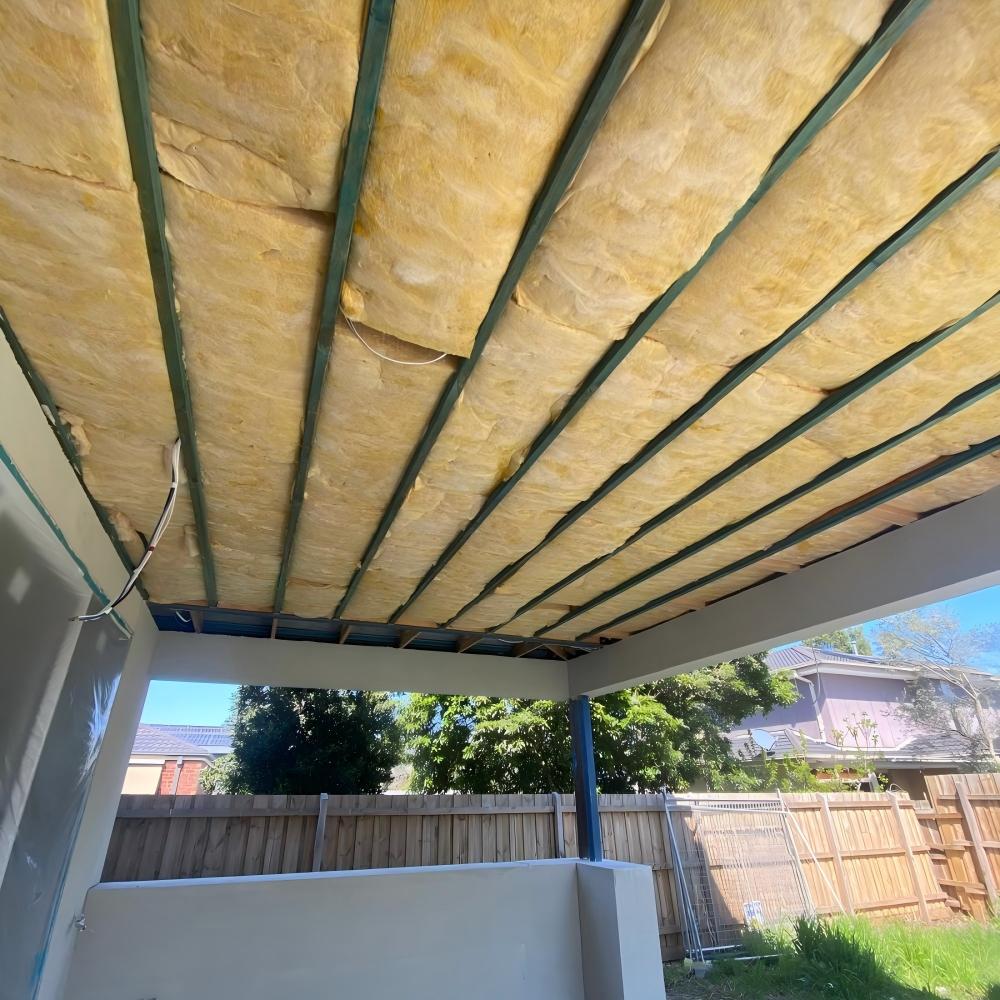
Glass Wool Felt is derived from raw materials like quartz sand and Borax. These are melted into long, soft, porous fibers. The density of United Insulation's product is 10-48 kg/m³, or 24-96 kg/m³ when it is in board form. It has low thermal conductivity at 0.034 W/(m·K) and a water repellency rate of at least 98%. It is light, flexible, easy to install, and suitable for pitched roof insulation and waterproofing work for flat roofs.
Rock Wool Board is derived from natural Basalt. It is spun at high temperatures into hard, stiff fibers. The density of United Insulation's product is 40-200 kg/m³, has an Acidity Coefficient of 1.6 or more, is extremely durable, and is widely used for tall industrial roofs. It has an A1 fire rating and is stable.
These two products are both inorganic fiber materials that are green products for a healthy environment. They are non-toxic, formaldehyde-free, and emit low VOCs. They are manufactured under REACH standards, which helps reduce a building's footprint during use. They are a key way to protect the environment and promote green development.
II. Core Performance Comparison (Data drawn from GB/T 10295-2021, GB 8624-2012, 2025-2026 Industry LCA reports)
The table below shows the latest actual parameters under normal conditions of use (average 25℃, according to national standards).
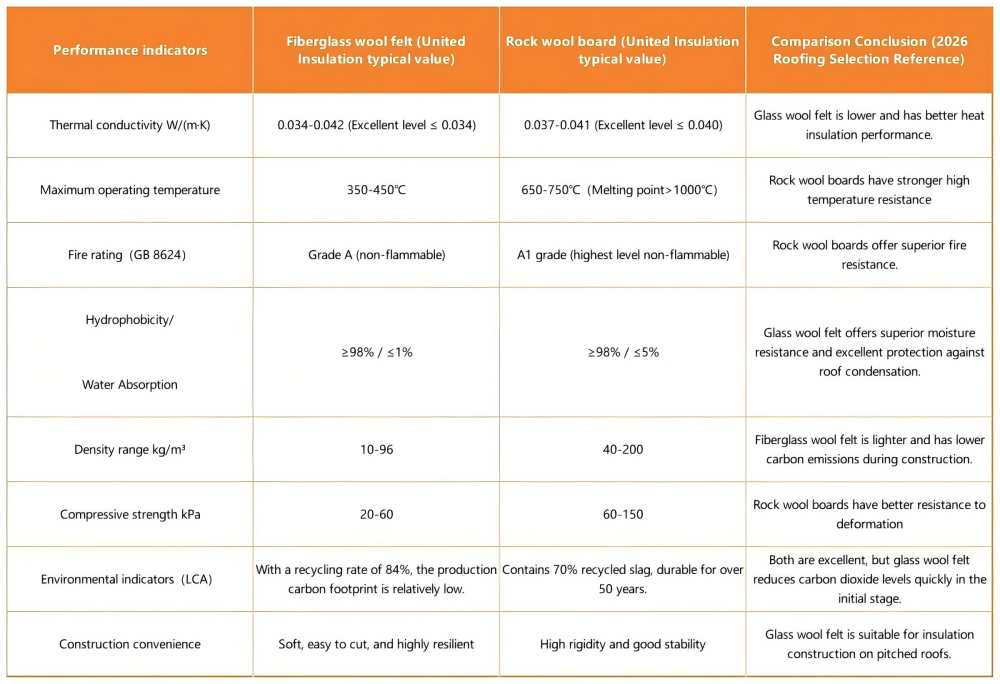
Thermal performance is a major factor to consider when making a decision about which roof insulation to use. In this case, glass wool felt has a notably low thermal conductivity that enables it to attain the same thermal resistance using 10-20% less thickness. This means that we are able to save materials while at the same time reducing carbon emissions from transportation. Rock wool boards are stable materials that are best used for roofs that are exposed to extreme cold or large temperature fluctuations.
Waterproofing and long life: The glass wool felt has a better ability to shed water while at the same time, when used with a waterproofing membrane, it is able to provide waterproofing as well as insulation. The rock wool boards are long-lasting materials that have a lifespan of more than 50 years, which means that we are able to reduce maintenance waste.
Fire safety: The rock wool boards are able to attain a top grade A1 rating while at the same time having a fire resistance of more than 4 hours, which is suitable for industrial roofs.
III. Deep Connection With Environmental And Ecological Protection – Roof Insulation And Its Significance In Achieving The "Dual Carbon Goals" And Ecological Balance
The most direct means of reducing a building's carbon footprint is through roof insulation. The results of the 2025-2026 Building Insulation Market Report and LCA studies show that roof insulation can reduce operating energy consumption by as much as 30-40%. In addition, it can reduce CO₂ emissions by as much as 15-30 kg per square meter of roof surface annually, depending on the region's climate. More specific results of LCA studies are as follows:
- Glass wool felt has a low carbon footprint in production, with up to 84% recycling rate. After application, it can reduce roof heat loss by as much as 35% in hot summer and cold winter regions, equivalent to planting 8-12 trees annually. The light weight of the material will result in lower carbon emissions during transportation, thus supporting green roof insulation and ecological protection.
- Rock wool board has as much as 70% of the raw materials sourced from recycled slag, providing good durability. LCA results show that it has over 40% carbon reduction efficiency in high-temperature industrial roof scenarios. In addition, roof insulation can alleviate the urban heat island phenomenon, reduce energy consumption of nearby air conditioning systems, and indirectly reduce carbon emissions.
Moreover, waterproofing and insulating roofs will prevent roof leakage, which causes waste of materials and soil pollution, thus extending the lifespan of a building. Choosing United Insulation's export-grade products, which are ISO 14001 certified, will ensure that a project will comply with EU REACH and China's green building standard, thus qualifying for energy saving subsidies and further fueling the development of low-carbon and ecological buildings.
IV. 2026 Roof Insulation: Scenarios and Materials
1) Pitched Roofs Insulation: Homes and Villas - Glass wool felt is recommended due to its lightness and ease of installation. It has an optimal thickness of 80-120 mm. It is recommended that it be covered with a waterproof material to seal the pitched roof.
2) Flat Roofs Waterproofing and Insulation: Commercial and Industrial Buildings - For this type, rock wool boards are recommended. It has high density and solid stability. It has an optimal thickness of 100-150 mm, making it suitable for inverted roofs waterproofing and insulation.
3) High-Rise Buildings and Public Buildings Roof- For these types, rock wool boards are recommended. It has high density and solid stability. It has an optimal thickness of 100-150 mm. It is recommended that there be no thermal bridging.
4) Humid and Coastal Areas - For these areas, glass wool felt is recommended. It has high resistance to moisture, thus avoiding condensation and mold growth.
5) Green Building Certification Projects - For these types, glass wool felt is recommended. It has an optimal thickness that can be determined from the economic thickness table.
V. Frequently Asked Questions (FAQ)
FAQ1: Between glass wool felt and rock wool board materials, which is more eco-friendly for roof insulation in 2026?
Both materials are eco-friendly. The low carbon footprint of glass wool felt and its 84% recycling rate mean that initial carbon emissions are low. The long life of rock wool board exceeds 50 years, has a higher percentage of recycled slag, and has better energy savings and carbon reduction potential throughout its life cycle. The decision of which roof insulation to use depends upon the region's climate and fire resistance needs. The decision can significantly reduce the carbon footprint.
FAQ2: How is the economic thickness of a roof determined to maximize roof savings?
Using GB/T 8174 economic thickness tables, if we consider the climate zone, 80-120 mm is recommended for hot summer/cold winter areas. For extremely cold areas, 150 mm+ is recommended. Because of its low thermal conductivity, glass wool felt can be 10-20% thinner to achieve the same thermal resistance as rock wool boards. If we increase the thickness by 20 mm, we can save 10-15% more carbon emissions. United Insulation offers free roof thickness calculations.
FAQ3: In roof waterproofing and roof insulation, which product is better at preventing condensation: glass wool felt or rock wool board?
Glass wool felt has a water repellency rate of ≥98% and a water absorption rate of ≤1%. It is better at preventing condensation, especially in hot and humid areas. Rock wool boards also have a 98% water repellency rate. However, it is more stable due to its density.
FAQ4: What is the safest roofing insulation product according to high-rise industrial roof fire safety standards?
Rock wool boards are at the top of fire safety rankings as they have the highest fire resistance rating of A1, a long fire resistance interval, and produce no toxic fumes. They are thus recommended as the best roofing insulation product for fire safety. The glass wool felt is also a non-combustible product that has A-grade fire ratings. It is recommended for mid- to low-rise buildings. United Insulation has test reports that provide assurance for the safety of roofing insulation products.
FAQ5: What precautions are necessary during construction of roofing insulation?
Glass wool felt is a flexible product that is easy to cut into desired sizes. It is also a tough product that can be relied upon during pitched roof insulation. Rock wool boards must be anchored to prevent settlement during pitched roof insulation. The products are also designed to produce low-slag balls that are non-dust-producing. United Insulation has guidelines for pitched roof insulation construction that are applicable to its products that are being exported.
Conclusion:
Glass wool felt is a top product that is recommended for roofing insulation due to its light weight, low thermal conductivity, and ease of use during pitched roof insulation. Rock wool boards are recommended for flat roofing insulation due to their fire resistance, toughness, and stable roofing waterproofing and insulation properties. In 2026, roofing insulation materials must be selected while considering cost savings, energy savings, and responsibility to protect Earth's ecology.
United Insulation offers export-grade quality glass wool felt and rock wool boards that have stable properties and full product certifications. The products are thus suitable for roofing insulation projects that are located in the Middle East, Southeast Asia, Europe, and other parts of the world. Contact us for free samples of 2026 products, economic thickness tables, LCA reports, and free roof thermal calculations. Let's work together to save the Earth by using green products that are low-carbon-emitting.
Related Blog
What are the side effects of glass wool? A comprehensive analysis of the safe use of insulation materials
What is ROCKWOOL used for? A comprehensive guide to the world's hottest non-combustible insulation material

Is rockwool better than foam?
Can rock wool catch fire? An in-depth analysis of fire resistance and ecological value
2025 Global Building Energy Efficiency Policies: Key Insights and Rock Wool Insulation Strategies
What are the side effects of glass wool? A comprehensive analysis of the safe use of insulation materials
What is ROCKWOOL used for? A comprehensive guide to the world's hottest non-combustible insulation material
Is rockwool better than foam?
Can rock wool catch fire? An in-depth analysis of fire resistance and ecological value
2025 Global Building Energy Efficiency Policies: Key Insights and Rock Wool Insulation Strategies
contact us