









High-Temperature Insulation for Industrial Boilers: Rock Wool Pipes vs. Glass Wool Pipes - Which to Choose for 600℃+ Scenarios?
2026-04-17
In 2026, in the face of the accelerated development of the "dual carbon" targets in the industrial field, i.e., the targets of "carbon peaking" and "carbon neutrality," the industrial boiler insulation and high-temperature equipment insulation have become the focal points in the battle for energy saving and carbon reduction. According to relevant reports, the heat loss in industrial pipelines and boilers accounts for 15-30% of the total energy consumption, and the heat loss in steam systems is even higher, at 20-40%. With high-quality high-temperature pipeline insulation, heat loss can be reduced by 80-90%, thus saving energy and reducing CO2 emissions, helping enterprises in the "green" and "low-carbon" transformation. As a professional export company in rock wool and glass wool products, United Insulation (www.unitedinsulation.com), based on its rich engineering experience in overseas markets and in accordance with the latest Chinese standards (GB/T 11835-2016 "Rock Wool, Slag Wool and Their Products," GB/T 17738-2022 "Glass Wool Products," GB/T 8174 Evaluation of Insulation Effects for Equipment and Pipelines), will give you a scientific comparison of rock wool pipe shells and glass wool pipes, two of the most popular materials in the market. This will help you make scientific selections for 600℃+ high-temperature pipeline insulation, steam pipeline insulation, boiler equipment insulation, and so on, thus realizing a win-win situation in economic and ecological benefits.
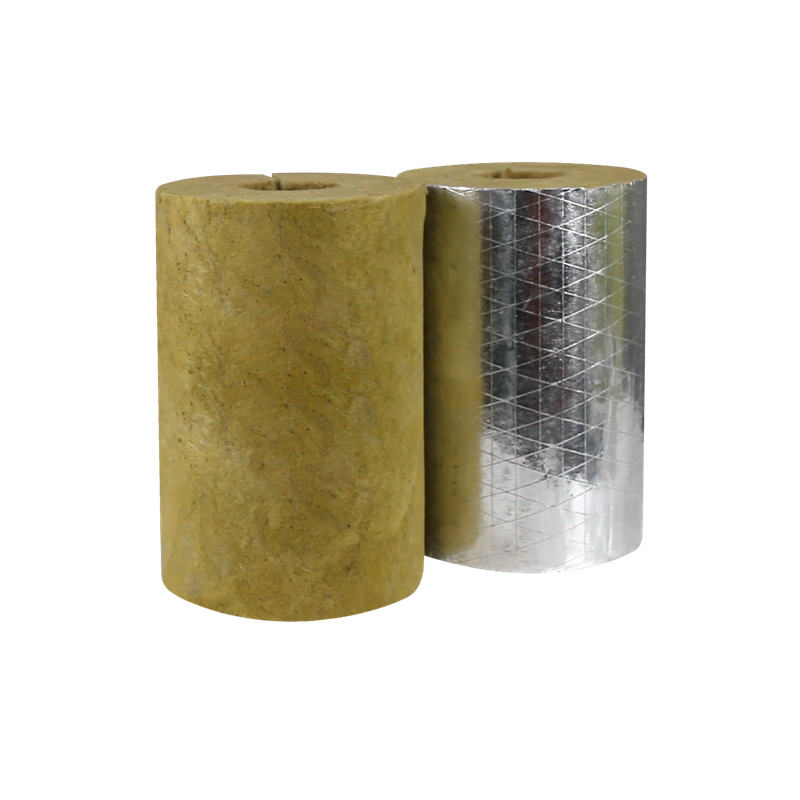
I. Basic Overview of Rock Wool Pipe Shells and Glass Wool Pipes
Rock Wool Pipe Shell (Rock Wool Pipe Section): Mainly composed of natural basalt, melted at high temperatures, centrifugal spun into fibers with large diameters and high rigidity. The density of the exported Rock Wool Pipe Shells is between 80-150 kg/m³, water repellency ≥98%, and corrosion resistance is excellent. The products are used in high-temperature industrial boiler insulation and steam pipeline insulation at 600℃+.
Glass Wool Pipe: Mainly composed of silica sand, borax, melted at high temperatures, spun into fibers with high lengths and softness. The density is between 40-100 kg/m³ with high water repellency. The products can be used in medium-temperature and low-temperature pipeline auxiliary cold insulation.
Both products are inorganic fiber green building materials with good environmental performance. They are formaldehyde-free with low VOC emissions. The manufacturing process complies with the REACH environmental policy, reducing heat loss in industrial enterprises during application. The products contribute to the protection of the environment and the development of the ecosystem.
II. Core Performance Comparison (Data obtained from GB/T 10295-2021, ASTM C547, and 2025-2026 reports)
The following table shows the latest actual parameters (average temperature range: 100-300℃, in accordance with national standards and authoritative tests around the globe):
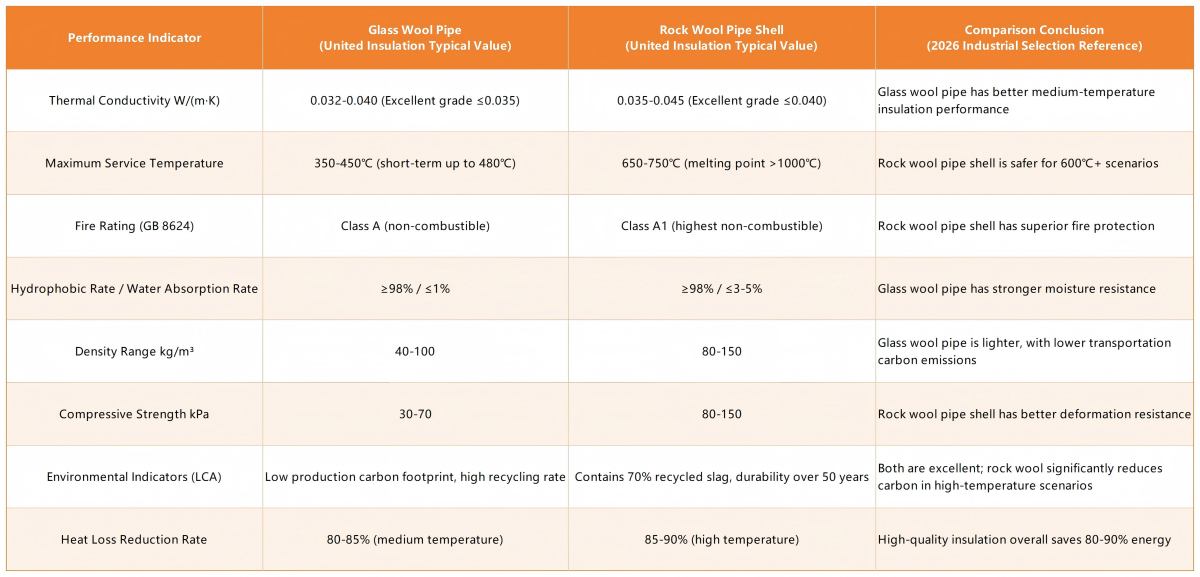
Thermal conductivity is one of the main parameters used in the insulation of industrial boilers. Glass wool pipes with their lower thermal conductivity have shown exceptional performance in the insulation of medium-temperature steam pipelines where the temperature ranges between 150-350℃. The thermal stability of the rock wool pipe shells is quite high at temperatures above 600℃; in addition, there is no chance of softening or shrinking.
Resistance to Temperature and Fire: The rock wool pipe shells can withstand temperatures up to 750℃; in addition, they are A1 fire retardant. They can be used in the insulation of high-temperature equipment and boiler furnace walls. The tests have shown that the heat loss is reduced by 85-90% at 600℃; in other words, the performance is far superior compared to the uninsulated condition.
Health and Safety: The two materials have lower slag content (≤0.3%), resulting in less dust during the process of installation; in addition, the workers will not be irritated by the dust. The materials are formaldehyde-free, meeting the industrial health standards.
III. Deep Connection with Environmental and Ecological Protection: How Industrial Boiler Insulation Contributes to the Achievement of the Goal of "Dual Carbon"
The surface heat loss of industrial boilers can be quite high, up to 500-1000W/m². However, with high-quality high-temperature pipeline insulation, this value can be reduced to only 10-50W/m², thus reaching an energy saving rate of up to 80-90%. Life Cycle Assessment (LCA) is a tool to analyze and measure the environmental impacts and ecological risks throughout the life cycle of a product. Based on this tool, the following is an analysis of the ecological and environmental protection capabilities of the products:
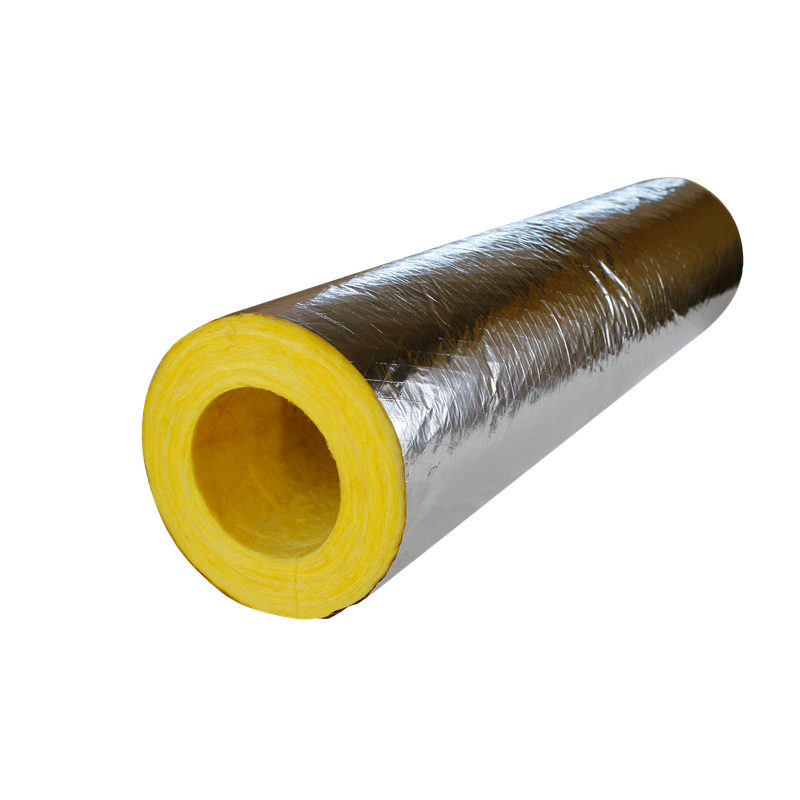
- Glass wool pipe: This type of product is suitable for medium-temperature boilers and has a lower carbon footprint. Example: In the case of chemical steam system pipes, if 80mm thick glass wool pipes are used, the heat loss will be reduced by about 35% every year. This is equivalent to reducing CO₂ emission by 50-100kg per meter per year, depending on the volume of the steam. This is an example of how glass wool pipes contribute to energy saving and carbon reduction in industrial boilers.
- Rock wool pipe shell: This type of product has high temperature resistance and high durability, with over 70% recycled slag content. Example: In high-temperature industrial boiler scenarios (temperatures over 600℃), the energy saving rate can reach up to 40-50%. If this type of product is used to insulate industrial boilers, the carbon reduction effect will be very significant. For every kilometer of rock wool pipe shell insulation, the carbon reduction will be tens of thousands of tons. This is equivalent to saving 20-40% of the consumption of natural gas and coal, reducing air pollution, and meeting the requirements of China's green industrial transformation and the EU's carbon trading policy.
Besides reducing carbon dioxide emissions, industrial boiler insulation can also reduce the heat island effect caused by thermal radiation to the surrounding environment. United Insulation products have been certified by the ISO 14001 environmental management system and have become a reliable low-carbon industrial insulation solution for overseas exports.
IV. Material Selection Guide for Typical Industrial Boiler Application Scenarios in 2026
1. 600℃+ High Temperature Steam Boilers (Refining, Power Plants): Rock wool pipe shells are recommended (temperature resistance up to 750℃, A1 fireproof rating); thickness 100-150mm, safe for high-temperature steam pipeline insulation.
2. Medium Temperature Steam Pipelines (150-350℃, Food Industry, Textile Industry): Glass wool pipes are recommended (low thermal conductivity, high cost-effectiveness); thickness 60-100mm.
3. Insulation of industrial boiler walls and equipment surfaces: Rock wool pipe shells have high rigidity and stability, suitable for high-temperature equipment insulation.
4. Humid or Condensing Environments: Glass wool pipes have high hydrophobicity, resisting condensation.
5. Green and Low-Carbon Retrofits: According to the results of the heat loss calculation, rock wool pipe shells are recommended to maximize the energy-saving and carbon-reducing benefits.
V. Frequently Asked Questions (FAQ)
FAQ1: What is more eco-friendly for boiler industrial insulation, rock wool pipe shells, or glass wool pipes?
Both rock wool pipe shells and glass wool pipes are eco-friendly and green, formaldehyde-free, and have low VOCs. In terms of eco-friendliness, glass wool pipes have a better carbon footprint and weights during production, thus having fewer emissions during transport. Rock wool pipe shells have better durability, more slag production, and better carbon reduction effects throughout the lifecycle in high-temperature scenarios. In terms of boiler industrial insulation for energy saving and carbon reduction, both have significant effects on the industrial carbon footprint.
FAQ2: Is it a must to use rock wool pipe shells for high-temperature pipelines above 600℃?
Glass wool pipes have a high safety risk because they will soften and shrink when the temperature is above 600℃. Rock wool pipe shells must be used for high-temperature pipeline scenarios because they have the highest temperature resistance of 750℃, a melting point above 1000℃, and an A1 fire rating. United Insulation has provided reports for the temperature resistance tests and heat loss calculations for rock wool pipe shells, helping you avoid mistakes in the selection of high-temperature pipeline materials.
FAQ3: How to calculate the boiler insulation thickness for energy saving and carbon reduction?
According to the economic thickness table of GB/T 8174 (combined with steam temperature), the recommended range is 80-120mm for medium temperatures, while high temperatures require 150mm+. Adding an extra 20mm can save an additional 10-15% on energy costs, which is equivalent to reducing carbon emissions by 10-15%. United Insulation offers free support for calculation of insulation thickness for industrial boiler construction.
FAQ4: What are the precautions for high-temperature equipment insulation construction?
Rock wool pipe shells: special attention is needed for the position of anchors and anti-settlement; glass wool pipes: easy to cut, high resilience; protective gear is necessary during construction; low slag ball design is adopted, reducing dust; these precautions can ensure the safety of construction.
FAQ5: How to Achieve Ecological Protection Benefits for Industrial Boilers Through Insulation?
High-quality insulation can reduce fuel costs by 20-40%, thereby reducing CO₂, SO₂, and NOx emissions; rock wool pipe shells can provide higher energy efficiency for high-temperature insulation, meeting the requirements of the 'double carbon' policy; LCA reports are attached to the export products, which can be used for green certification.
Conclusion:
Rock wool pipe shells have excellent high-end performance in high temperatures, high fire resistance, and long service life, which can be used for high-temperature insulation of pipelines above 600℃; glass wool pipes have low thermal conductivity, light weight, and high cost-effectiveness, which can be used for medium-temperature insulation. In 2026, choosing high-temperature insulation materials for industrial boiler construction is no longer just about reducing costs and saving energy; it is about fulfilling the responsibility of green transformation in the industrial sector.
United Insulation (www.unitedinsulation.com) provides export-grade rock wool pipe shells and glass wool pipes with stable parameters and complete certifications, serving high-temperature equipment insulation projects in the Middle East, Southeast Asia, Europe, and other regions. Contact us to obtain the latest product samples, technical parameters, LCA reports, and free material selection consultation for 2026, and work together to promote low-carbon industrial development!
Previous:
Next:
Related Blog
UET rock wool batt: high-efficiency and energy-saving insulation material

Xinjiang team building
United Insulation successfully exports high R value glass wool into the US market to support energy-saving upgrades in North American green buildings
UET offers customers solutions for reducing shipping costs
A Comprehensive Guide to Glass Wool Soundproofing
UET rock wool batt: high-efficiency and energy-saving insulation material
Xinjiang team building
United Insulation successfully exports high R value glass wool into the US market to support energy-saving upgrades in North American green buildings
UET offers customers solutions for reducing shipping costs
A Comprehensive Guide to Glass Wool Soundproofing
contact us